
Peekskill City Directory Holdings
The verified shelf begins with the New York State Library's Peekskill directory film list. It records selected years rather than an uninterrupted run, so the collection is best used as a dated series of snapshots. A listing can tie a name to a street, a spouse or widow notation, and an occupation line, but it remains a historical publication rather than a current address record. Keep the title page, year, page, and any volume designation with every transcription.
| Collection | Years | Where Held | Access |
|---|---|---|---|
| Historical directory volumes | 1875; 1885-86; 1892-93; 1896; 1902-03; 1919; 1927-29; 1931; 1940-42 | New York State Library film/catalog | Film or repository access |
| Directory reel finding aids | 1903-59, with documented gaps | Gale/Cengage reel guide and repository copies | Verify the reel or scan first |
| Peekskill 1963 lookup | 1963 | NYGenWeb finding aid; Field Library, FHL, and NYPL named as repositories | Lookup or repository dependent |
| Local newspapers and community records | Historic runs, coverage varies | Field Library and Community History Archives | Free online archive; check each run |
Catalog presence does not establish a freely viewable scan. The verified holdings do not identify a single first or last printed Peekskill volume, and a publicly cataloged complete reverse-directory run was not found. Ask the repository to confirm the volume, its format, and whether a street-order section is present before planning an address search.
Peekskill Directory Film Years
The New York State Library city-directory list is the most precise published starting point for Peekskill. Its dates make it possible to choose a volume near an event instead of assuming that a directory was issued every year. Begin with the closest listed year, then check the next available volume for a move, a changed initial, or a spouse notation. That simple comparison protects against treating a gap as proof of absence.
Consult the State Library listing for Peekskill directories before requesting film or a reproduction.
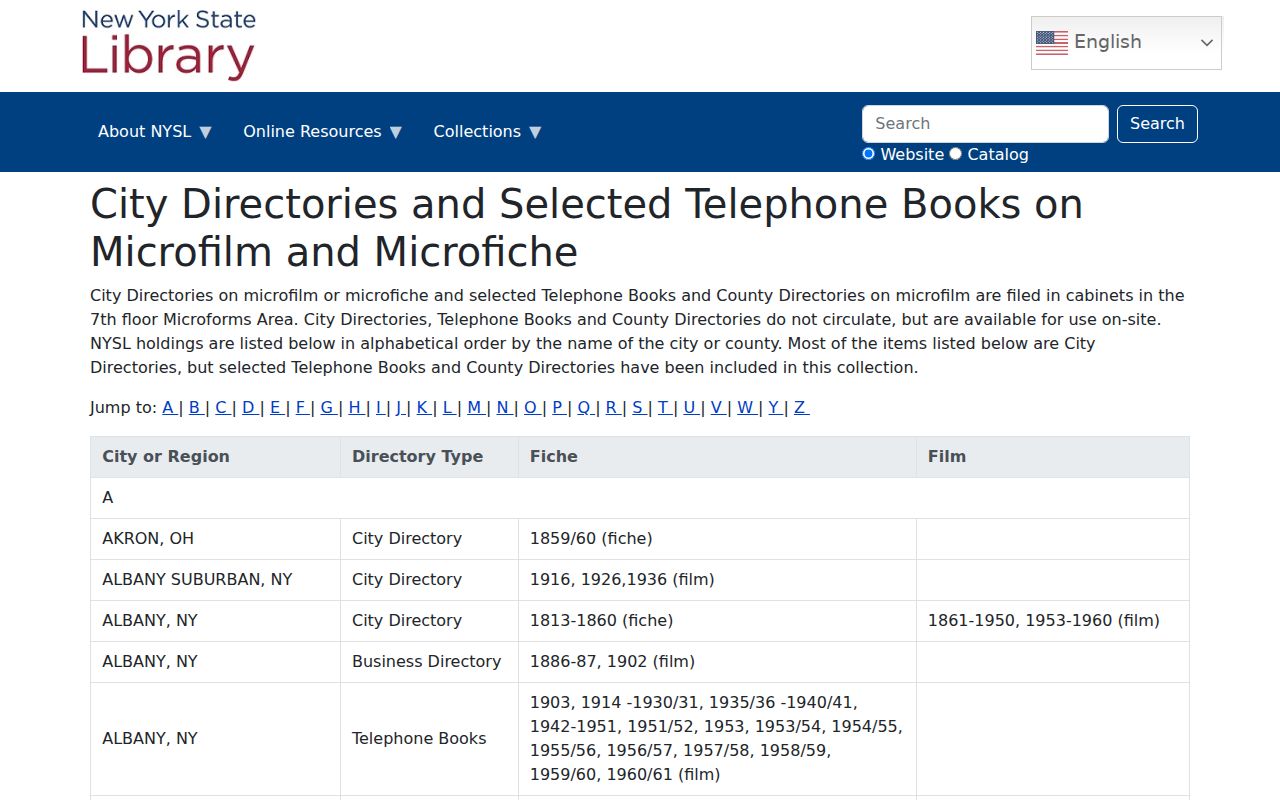
The institutional entry point is not a promise that every listed year can be read online or searched by name.
Peekskill Directory Reel Gaps
NARA's circa-1930 aid names Peekskill for 1927-29, 1931, 1933, and 1935. A broader reel guide describes 1903-12, 1913-25, 1927-35, 1938-48, and 1952-59 runs. It also identifies missing 1920-23, 1930, 1932, 1934, 1943-45, 1948, 1953, 1955, and 1957 volumes. Those descriptions are guides to possible reels, not confirmation that a chosen repository holds each item.
| 1875 | Earliest Peekskill year confirmed by the NY State Library list. |
|---|---|
| 1927-35 | NARA identifies selected Peekskill volumes; the reel guide flags 1930, 1932, and 1934 as missing. |
| 1940-42 | Confirmed on the State Library list. |
| 1952-59 | Described by the reel guide with 1953, 1955, and 1957 gaps; repository verification is required. |
The known Peekskill directory record unfolds in dated points rather than a single continuous set.
- 1875: the earliest Peekskill directory year verified in the State Library holdings.
- 1903-59: the wider reel guide describes several runs, with the stated missing years.
- 1927-35: NARA identifies selected Peekskill volumes, including 1927-29, 1931, 1933, and 1935.
- 1963: a NYGenWeb finding aid directs searchers to Field Library, FHL, and NYPL repositories.
Note: A missing guide year means only that the listed reel lacks it, not that no local copy or newspaper substitute exists.
Peekskill Directory at Field Library
The Field Library, founded in 1887, is the strongest local-history starting point when a directory query needs context. Its institutional material highlights Couch family genealogy and local lore, while its Community History Archives brings together newspapers, photographs, maps, directories, and community records. Ask staff whether a target year has a paper volume, film, reverse or criss-cross section, telephone book, yearbook, obituary file, or licensed database. Those exact holdings were not fully cataloged online.
See Field Library's local-history entry point before arranging a Peekskill directory visit.
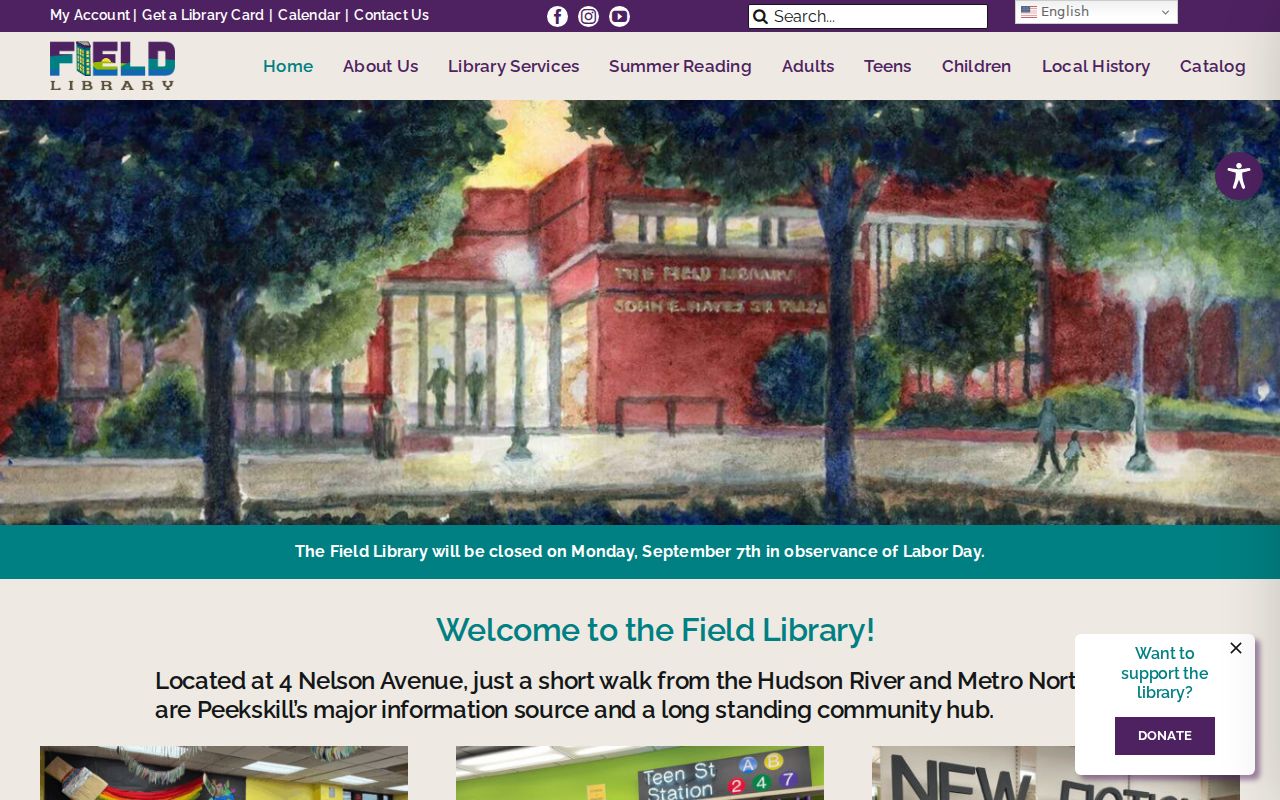
The library's collections can supply the local setting that a bare directory line cannot, but each item still needs a year and source citation.
Peekskill Newspaper Directory Leads
A directory address becomes more useful when it is checked beside a dated notice. The Field Library's free digitized Peekskill newspaper portal can be searched by surname, address, organization, and spelling variant. Its historical materials include the Peekskill Messenger runs noted for 1861-1893. NY State Library holdings also document the Highland Democrat from 1859-1940, with gaps. Save the issue date and page because a newspaper may repeat an address that was already stale.
Older residents can also be checked against the Westchester Historical Society's cemetery index, which includes Hillside Cemetery and Presbyterian Church Yard. The listed Peekskill City Historian position is presently vacant, so Field Library, the Historical Society, County Archives, and the City Clerk are the practical routes for local-history questions.
Read a Peekskill City Directory Entry
Read the volume's front matter before copying a line. The chosen volume may give a name, spouse or relationship notation, occupation or employer wording, street address, house or occupant notation, owner mark, widow notation, and abbreviations or cross-references. The actual Peekskill scan and its abbreviation key were not inspected for this research, so the symbols must be read from the chosen volume instead of expanded from memory. Do not create a sample person from a pattern.
| Name and relationship | Record the spelling, initials, spouse or other relationship notation exactly as printed. |
|---|---|
| Occupation or employer | Copy the wording and punctuation; it is a dated identity detail, not proof of a later address. |
| Street and house detail | Capture the number, street, house or occupant notation, and any owner mark. |
| Widow and cross-reference marks | Transcribe widow notation, abbreviations, and cross-references, then consult the volume's key. |
- Criss-cross directory
- A section arranged by street and number rather than by surname, useful only when that specific volume includes one.
- Householder index
- An index organized around the named household entry; it may omit other people at the same address.
- Abbreviation key
- The volume's own explanation of shortened words and symbols. Photograph or transcribe it before interpreting h/r, widow, or other marks.
Peekskill Directories and Sanborn Maps
Directories identify people and street numbers. Maps answer a different question: what stood at that place. The Library of Congress holds a July 1911 Peekskill Sanborn set with 37 sheets, while Westchester Archives lists a 1900 Peekskill, Verplanck, and Buchanan microfilm set. These maps can show street and house numbers, footprints, use, material, height, lot boundaries, water mains, hydrants, and fire features. They do not identify every person who lived there.
Use the Library of Congress Peekskill Sanborn set after locating an address in a directory. Comparing the 1900 and 1911 map sources can help bridge an address change, then a directory, newspaper, deed, or census entry can test the household connection.
Map evidence also helps with a directory’s changing municipal language. Peekskill became a city in 1940 and earlier material can be indexed under Peekskill, a village or ward label, or Cortlandt. A house number that appears to shift should be checked against the street, parcel description, adjoining owners, and map sheet before it is treated as a move. The research did not locate a complete formal history of street renumbering, so the map and sequential directory method is safer than inventing an explanation for a changed number.
Trace Peekskill Directory Households
One household trail should be built from dated entries, not from a single attractive match. Start with the street or surname and record every spelling, initial, spouse notation, and address. Federal census schedules released through 1950 provide useful household checks: 1870, 1880, 1900, 1910, 1920, 1930, 1940, and 1950 are the closest federal comparison points for the directory years. Schedules released after the 72-year rule become available over time. A record may be filed under Peekskill, Cortlandt, a village, ward, or another historic label, so test the address as well as the name.
- Choose the closest confirmed directory year and capture the entry with its page, address, and every spelling variant.
- Compare the next available directory, not an assumed annual edition, and note a changed number, spouse notation, or surname form.
- If the volume includes a criss-cross section, check the same address in street order and keep its abbreviation key with the note.
- Pair the address and household with the closest available census release, then test the relationship with a deed, newspaper notice, or map.
- When a name disappears, check newspapers, the cemetery index, and the Surrogate index for a death, estate, executor, or later family lead.
A disappearance can mean a move, death, changed listing form, or simple omission. It does not establish what happened by itself. The Peekskill resident lookup route is better for a separately verified modern record, while this historical trail remains tied to the dates and limits of each source.
Limits of a Peekskill Directory
A historical directory is not a complete household roll and does not prove a current residence. Listings can lag a move, use initials, omit a person, or describe an address differently from a deed or census. A street-order section is not guaranteed, and exact Peekskill reverse-directory holdings remain a library follow-up. Preserve uncertainty where a record gives only a surname or an address without a second anchor.
For a historical family question, compare at least two independently dated sources. For a property question, distinguish a directory occupant from a recorded owner. For a current address question, use the appropriate current custodian rather than carrying a historical directory result forward.
Note: Directory evidence is strongest when its date, page, address, and a separate supporting record all point to the same household.